How to design a personal curriculum to deepen knowledge, achieve goals and become the most interesting person in the room.
From instilling a sense of perfectionism through the pursuit of good grades to focusing more on Pythagorean theory than practical skills like budgeting, the educational system has a lot to answer for. But, if there’s one thing you could never accuse it of, it’s being unstructured. At every point in primary, secondary and tertiary education, we’re told exactly what to do, when to do it and how to succeed at it.
That’s thanks, in large part, to the curriculum: The pre-determined learning plan that outlines what information should be taught, read and consumed for students to reach key learning outcomes on that topic. Usually standardised across all schools or colleges in the country, this curates the ‘best’ resources on that subject and breaks it down into a week-by-week plan for the semester.
As we all eventually learn, the real world and workforce don’t come with a curriculum (or, for that matter, a rubric that outlines what ‘good’ looks like). Things are far more open-ended and subjective. There is so much to learn, so many skills to master, and so many projects you could be working towards that it feels overwhelming — and the constant stream of stimuli we’re all bombarded with daily certainly doesn’t help.
Whether it’s ending up 50 IMDB pages deep after wondering where you’ve seen that actor before or Googling the logistics of becoming a DJ after seeing one Reel, we’re all guilty of going down rabbit holes from time to time. Often, when we finally snap out of it and realise we’ve been scrolling for an hour, this is accompanied by a sense of shame around the time we’ll never get back.
But, what if we could actually reclaim the research rabbit hole and turn it into a powerful tool for personal and professional progress — just by adding more structure? Enter, the concept of a self-learning curriculum.
What is a self-learning curriculum?
If you’ve spent any time on Substack or TikTok, you’ve likely come across the idea of a ‘personal curriculum ’. This is a self-directed learning plan built entirely around your own interests, curiosities and goals. While the creators design curricula primarily for their own satisfaction and self-growth, many have also built brands and communities around them.
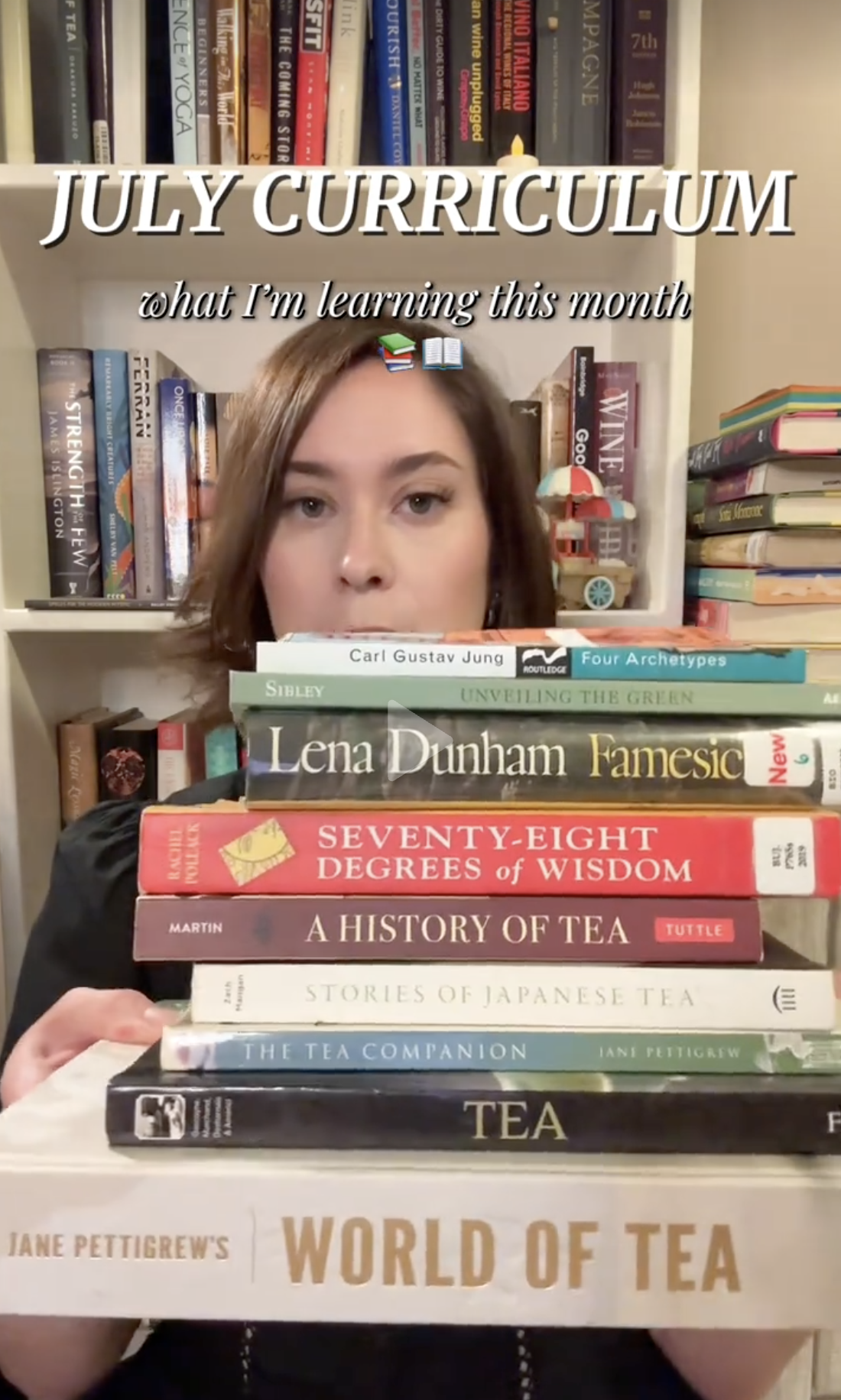
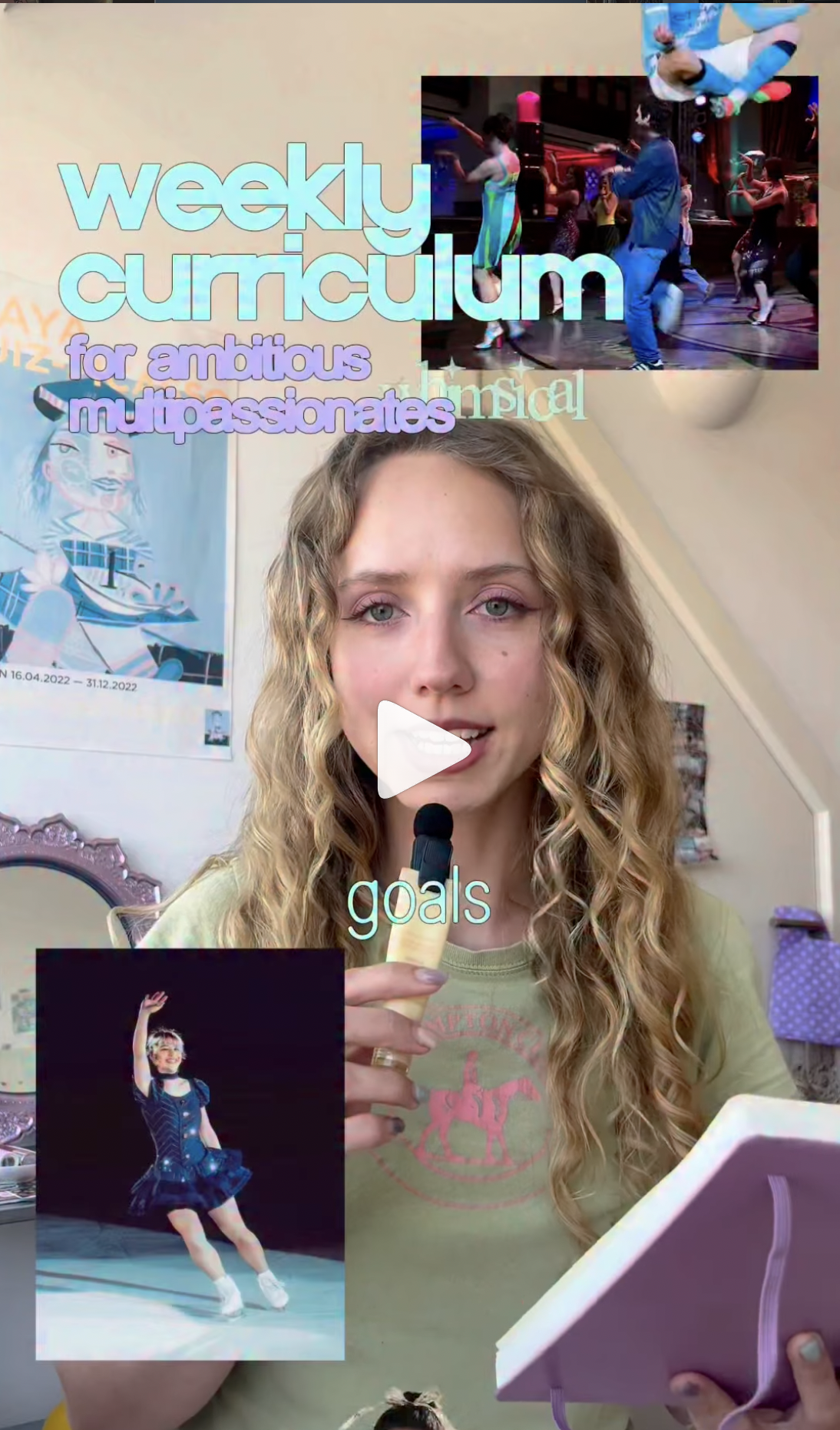
Perhaps the OG pioneer of this trend, Elizabeth Jean, or ‘xparmesanprincessx’ on TikTok, has been sharing her monthly personal curricula since back in 2022. She’s delved into everything from astrology and Jungian psychology to tea ceremonies and yoga, all in the name of infusing whimsy into her life. Over on Instagram, behavioural scientist @katafairy shares a weekly syllabus for multipassionate women around topics like goal setting, self-acceptance and side hustles. Meanwhile, Substack is home to endless long-form articles from introspective self-scholars sharing what they’re nerding out on that month.
Interestingly, it’s mostly female creators championing the idea of the ‘personal PhD’: perhaps in an effort to decentre the male gaze and build a well-rounded identity beyond just what they look like. And, they’re certainly onto something. Curiosity — about ourselves, other people and the world around us — is a fundamental ingredient for a fulfilling life. Lifelong learners tend to be happier, sharper and welcome more opportunities into their lives. Not to mention, there’s no better dinner party guest than the multifaceted person who is interested in and knowledgeable about lots of different things.
While it may seem awfully Hermione Granger or Rory Gilmore to create a detailed curriculum for yourself, they’re not just for the type A sorts. In fact, for multipassionate women who always have a million ideas but not enough time or sustained interest to pursue them all, they can actually be the perfect way to make meaningful progress. The self-curriculum adds structure around your goals, interests and — let’s face it — current hyperfocuses — so you have a clear path for exploration.
The anatomy of a self-curriculum
There’s no right or wrong way to create your own curriculum. Unlike at school, the beauty of self-study is that it’s done solely for your own enjoyment: there are no grades awarded at the end! That said, if it’s been a while since you put your learning cap on — or, you just want to rabbit hole-proof your project — there are a few key elements to consider.
The theme
Every self-curriculum needs a focus. You might choose to have an overarching theme for your year, quarter or month: for example, matrescence (the physical, emotional and psychological transition involved in becoming a mother). Then, under that umbrella, you could research biological hormonal changes, time management strategies for mothers and maternity style. Or, you might instead decide to go deep on one narrower topic you’re curious about, like Greek mythology. Don’t overthink it — just find that small spark of inspiration, and follow it.
The foundations
Just like every school or university subject has its core textbook or readings, it’s then time to identify the seminal works on your chosen topic. This is a piece of literature, art or research that profoundly influences the trajectory of that discipline — shaping everything that comes afterwards. For example, if your theme is self-actualisation, Carl Rogers’ 1961 On Becoming A Person is considered the definitive work on that subject. This will become the foundation for your self-curriculum, so you’ll want to carve out time each week to ‘study’ it.

The theoretical lens
It’s perfectly fine to dive into your area of interest with a completely open mind. But, if you want to approach your self-curriculum like an academic researcher, you may want to choose a theoretical lens to scaffold your learning. This helps to give you parameters around your research and helps inform how you think about things, so you don’t become overwhelmed. For instance, if your self-curriculum is all about the intersection of body image and pop culture, you may choose post-feminism as your theoretical framework. This can be particularly useful if you want to incorporate any writing (such as personal essays) in your research project.
The media list
From podcasts and YouTube videos to books, online articles and magazines (hello!), there are many different sources that can make up your self-learning curriculum. Because you can’t possibly read, listen to or watch everything on a given topic, you’ll want to curate your media list. AI can be valuable here for helping you mine the gold, as can be checking out other people’s pre-vetted self-curriculums on similar topics. Depending on how much time you have available, you’ll likely want to choose 1-3 pieces of media to consume each week.
The homework
Yes, you’re giving yourself homework — but, it’s much more fun when it’s self-prescribed and on your own terms! Whether it’s journaling prompts, writing exercises or a slideshow you present to your loved ones (lucky them!), reflective activities are a great way to put what you’re learning into practice. Nobody ever has to read these; they’re just for you. If you do decide to turn them into something you publish or share with the world, then that’s just a bonus.
The field trip
Often, the best learning happens out in the real world, not in the pages of a book or in front of a computer screen. So, just as you may have once piled onto a schoolbus to visit the beach and learn about erosion, it’s time to get out and about. Whether it’s heading to your local botanical gardens with a sketchbook or visiting an arthouse cinema, consider what outings could complement your curriculum — and put them in your calendar.
The timetable
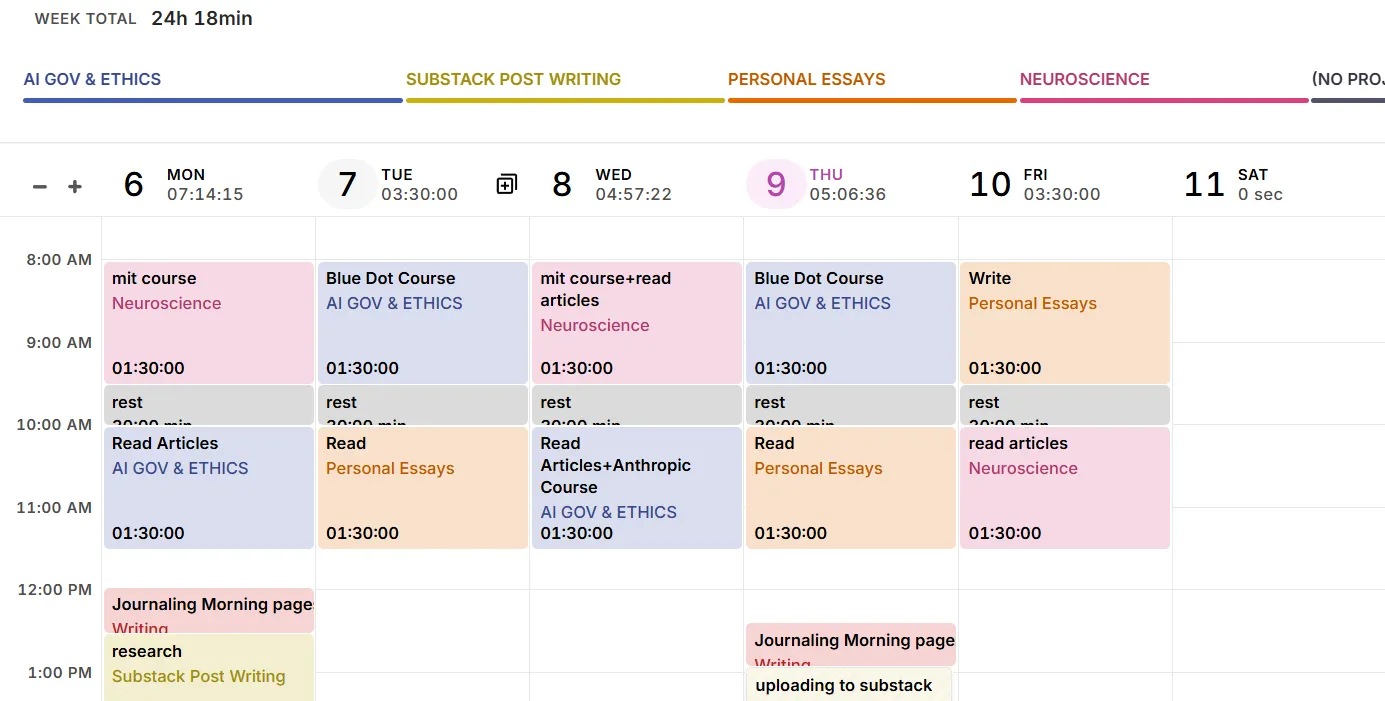
Speaking of calendars, utilising one is wise — to ensure you actually stick to your personal curriculum and it doesn’t end up in the pile of unfinished projects. This is where your foundational reading/watching, media list, homework and field trips all come together into a holistic syllabus. Here, you can see how Celine of La Vie En Bleu structures her self-study calendar. Of course, you don’t need to dedicate over 24 hours per week to yours: work within the confines of your own schedule. But, by blocking out what you’re going to do and when, it’s far less likely to fall by the wayside.
Helpful tools and tips
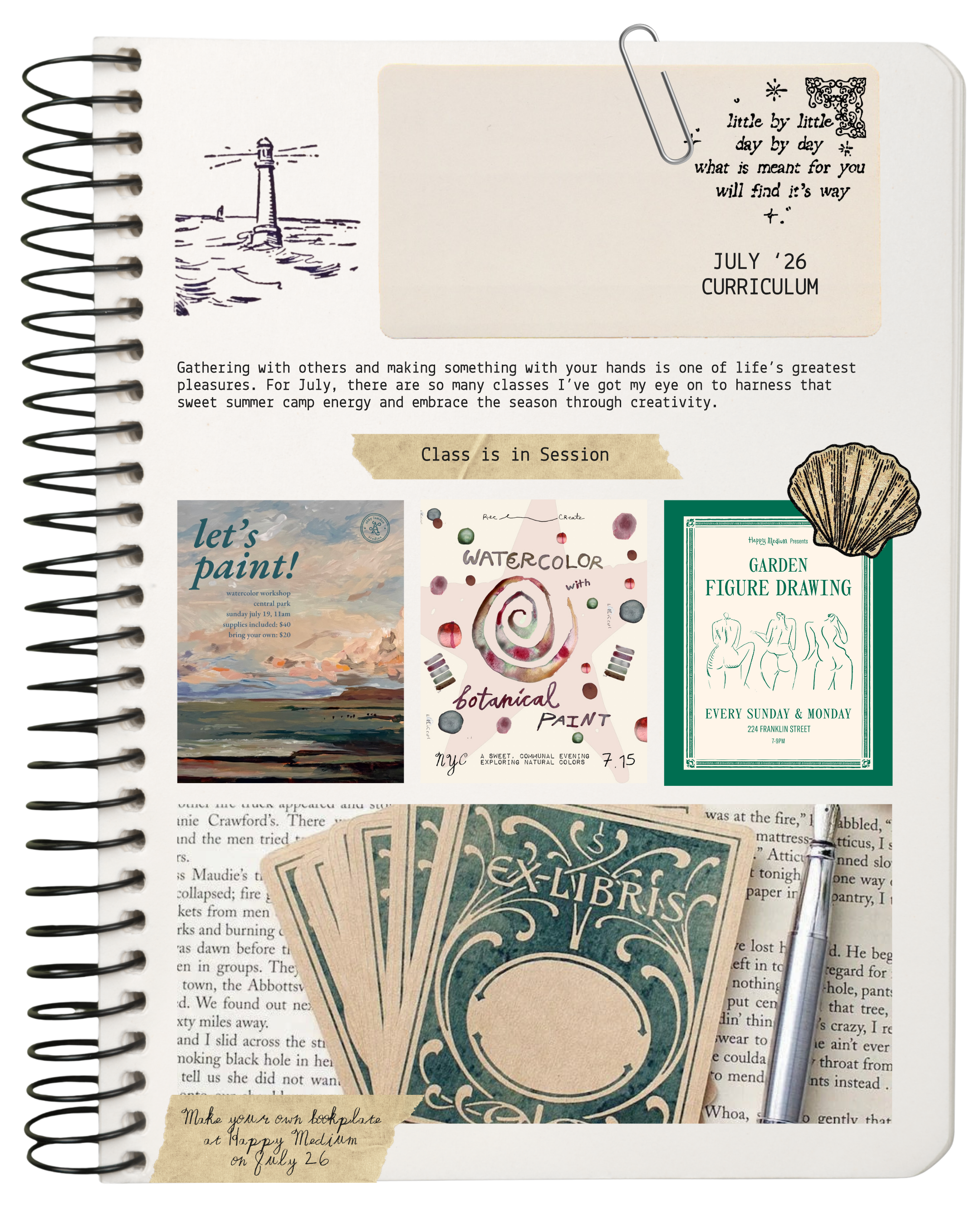
- Not sure what to study? Kyla James of ‘Boring Things’ on Substack has a list of over 200+ topics to “study like a 17th-century scholar” spanning literature, film, history, science, folklore, conspiracy theories and more
- Many self-guided researchers swear by knowledge management tools like Notion to organise their curriculum and findings in an aesthetically-pleasing and organised way. If you’re more of a ‘mindmap’ kind of person, you might enjoy Obsidian
- Google’s Notebook LM has some excellent tools for self-guided research to suit different learning tools, including audio/video overviews, and podcasts, infographics, data tables and slide decks. You can also use the mindmap and study guide tools to help connect the dots between topics and inform your self-curriculum
- If you’re exploring scientific literature as part of your curriculum, make like a PhD student and use tools like Connected Papers, Atlas, Google Scholar Labs and Elicit to help you make sense of it all
- To help you build the habit of self-study (especially if you’ve been out of the game for a while), you may want to carve out a dedicated space for it. Think cosy pillows and blankets, your favourite tea, soft lighting and nice notebooks and pens. A great study playlist goes a long way, too!
- Whether you’re a voice notes person or want to channel the ancient art of marginalia (scribbling in the margins of books), make sure to keep track of what intrigues you, confuses you or ignites any type of emotion. These are valuable clues for what you should research next
Get inspired
Ignite your curiosity with these example curricula from savvy-self scholars.
Mother nature curriculum
By Wren from Brown Study Guide on Substack
“Indigenous wisdom and culture study, magical and metaphysical botanical exploration, birdwatching and wildlife appreciation”
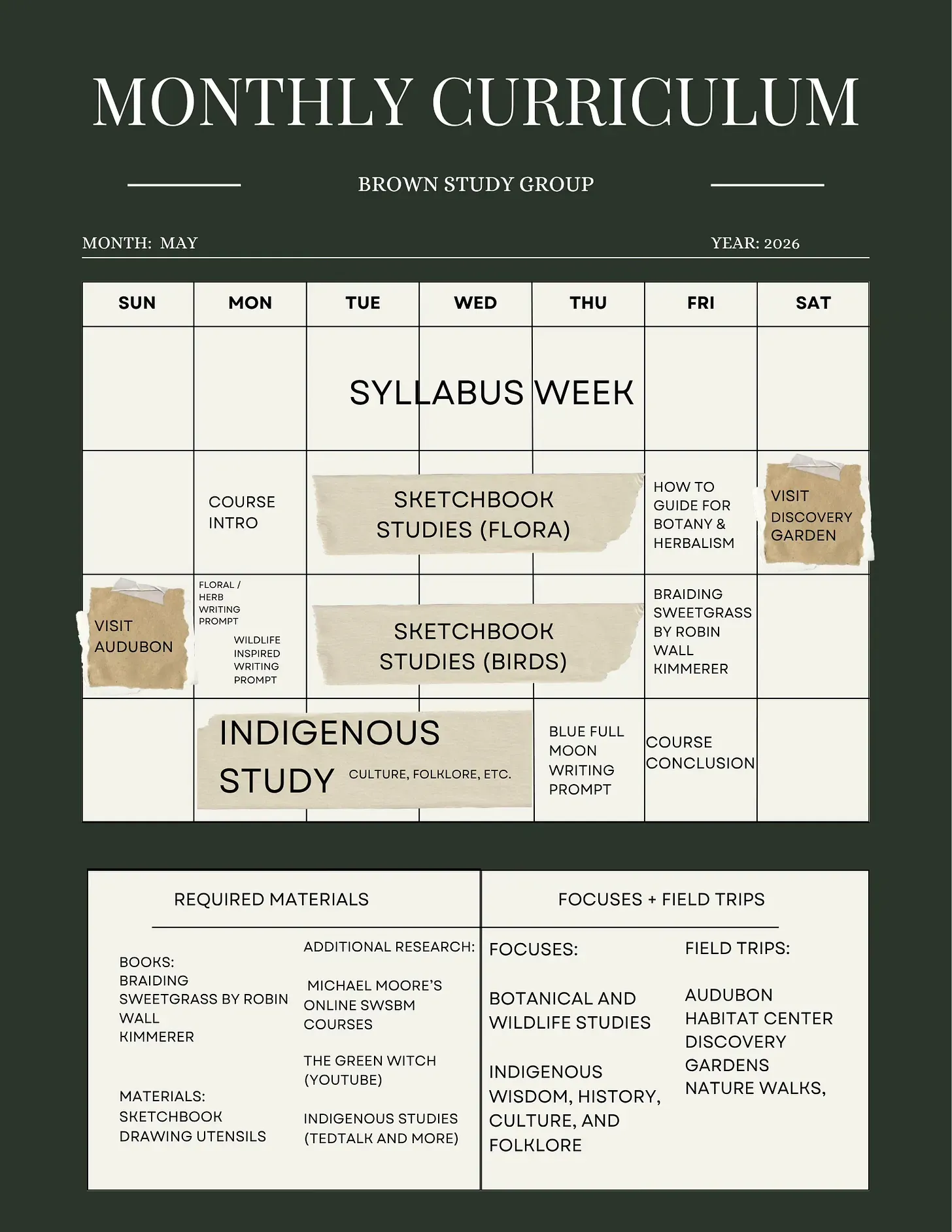
Botany and herbalism studies
- FREE Resource provided by Southwestern School of Botanical Medicine: swsbm.org.
- Videos by the Green Witch on Youtube.
- Sketchbook
Wildlife studies
- Field trips (nature walks)
- Plant and bird identifier apps
Book of the month: Braiding Sweetgrass by Robin Wall Kimmerer
Writing prompts:
- Flora and herbs
- Wildlife inspired writing prompts
- Blue full moon writing prompt
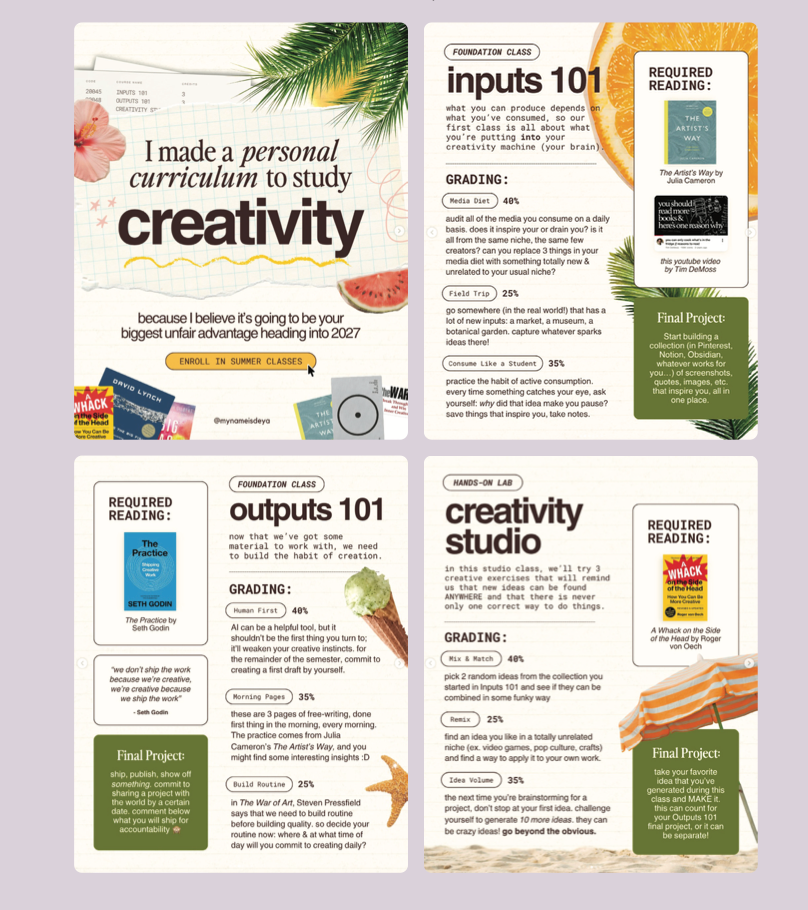
Creativity curriculum
By Deya of @mynameisdeya on Instagram